
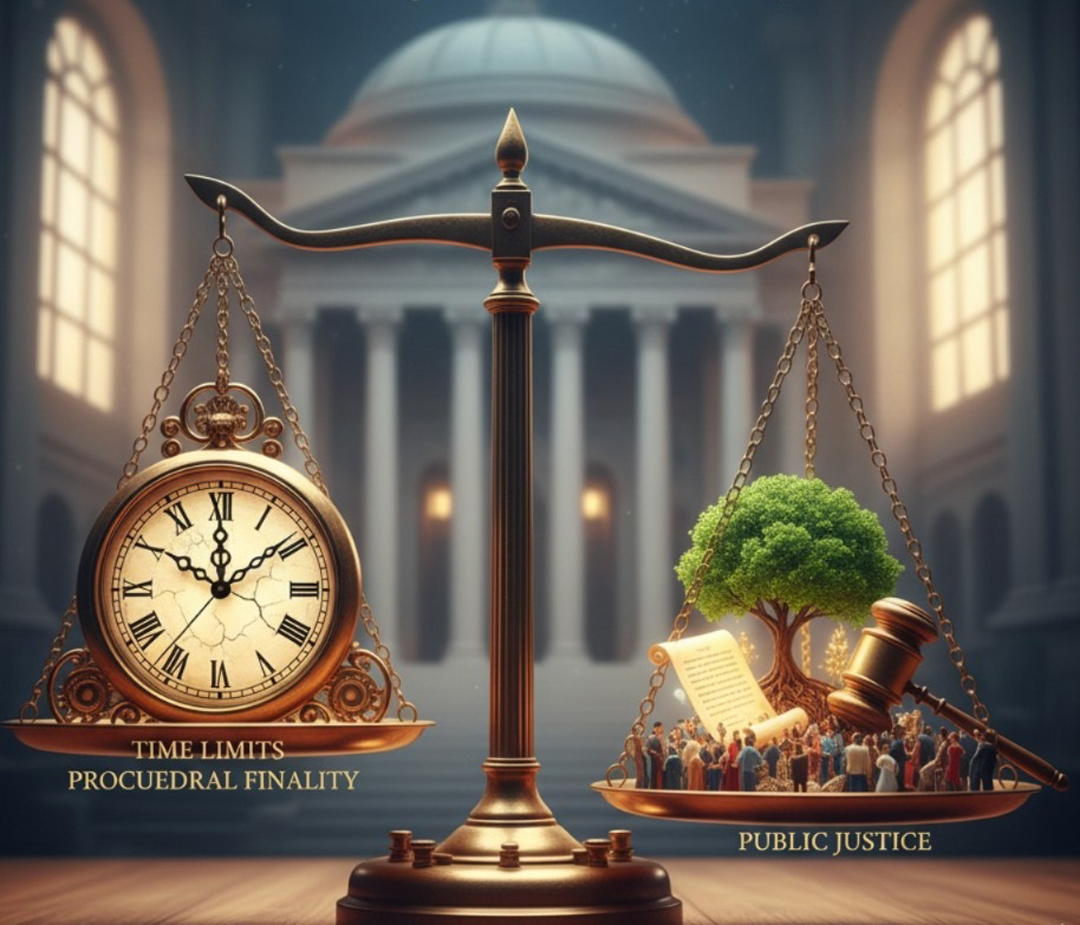
Can Courts Condone Delay In The Interest Of Public Justice?
Introduction
Time limits are a cornerstone of India’s justice system, designed to ensure finality and prevent stale claims from lingering indefinitely. The Limitation Act, 1963, prescribes specific periods within which legal proceedings must be initiated. However, as guardians of fairness, Indian courts often face situations where rigid adherence to these deadlines could lead to injustice, particularly in cases involving broader public interest. This tension between procedural finality and substantive justice has given rise to the doctrine of condonation of delay, allowing courts to excuse late filings under certain conditions. This article explores whether courts can condone delays in legal proceedings when public interest is at stake, even after significant lapses of time, and examines the legal framework, judicial approaches, challenges, and recent trends."
Legal Framework: The Limitation Act, 1963
The Limitation Act, 1963, provides the statutory basis for addressing delays in legal proceedings. Section 5 allows courts to admit appeals or applications filed beyond the prescribed period if the applicant demonstrates "sufficient cause" for the delay. The term "sufficient cause" is deliberately flexible, enabling courts to interpret it broadly to prevent injustice. While private disputes typically require strict diligence, courts adopt a more lenient approach in cases involving public authorities or significant public interest, prioritising justice over technicalities.
Judicial Approach: Flexibility in Public Interest Cases
Indian courts have consistently held that limitation rules are meant to facilitate justice, not obstruct it. In cases involving public rights or state actions, courts are more inclined to condone delays, provided there is no evidence of bad faith or gross negligence. Key judicial principles include:
State as a Litigant
In State of Nagaland v. Lipok Ao (2005) 3 SCC 752), the Supreme Court recognised that the state’s complex decision-making processes can justify some leniency in condoning delays. The Court emphasised that a rigid, technical approach should not override substantial justice, particularly in matters involving public authorities.
Public Interest Litigation (PIL)
In PIL cases, courts are notably flexible, acknowledging that issues like environmental protection, human rights, or constitutional governance often involve marginalised groups who may not act promptly. For example, in Rural Litigation and Entitlement Kendra v. State of U.P.(1989) Supp (1) SCC 504), known as the Dehradun quarrying case, the Supreme Court overlooked delays to address environmental concerns, prioritising ecological balance over procedural strictness.
Land Acquisition and Compensation
Courts have excused delays in cases involving illiterate or economically disadvantaged claimants, especially in land acquisition disputes. In Imrant Lal v. Land Acquisition Collector (2014) 14 SCC 133), the Supreme Court held that technical delays should not deny substantive justice when property rights or fair compensation are at stake.
Balancing Discretion: Limits to Condonation
While courts exercise leniency, their discretion to condone delays is not unlimited. Key considerations include:
Bona Fides: Deliberate delays, negligence, or ulterior motives may lead courts to deny condonation.
Length of Delay: Longer delays require stronger justification, though no fixed threshold exists.
Third-Party Rights: Condonation is less likely if it prejudices the rights of others who relied on the limitation period.
Nature of the Issue: Matters involving constitutional rights, fundamental freedoms, or public interest receive greater flexibility.
For instance, in Pundlik Jalam Patil v. Jalgaon Medium Project (2008), the Supreme Court refused to condone a delay when the reasons provided were frivolous, signalling that public authorities cannot routinely rely on bureaucratic inefficiencies.
Public Interest as a Guiding Principle
Public interest is a pivotal factor in condonation decisions. Courts recognise that some cases transcend individual disputes and impact society at large, justifying a departure from strict procedural norms. Examples include:
Environmental Protection: Courts have entertained delayed petitions addressing pollution or deforestation due to their long-term societal impact.
Human Rights: In cases of custodial deaths or systemic discrimination, delays are often overlooked to ensure accountability.
Government Appeals: Courts may condone delays in state appeals involving public funds or policy, provided the merits warrant consideration.
Public interest thus serves as a compelling reason to excuse delays, provided there is no abuse of process
Criticisms and Challenges
The liberal approach to condoning delays in public interest cases raises several concerns:
Uncertainty: Overly lenient condonation undermines the predictability and finality that limitation laws aim to ensure.
State Exploitation: Government entities may become complacent, expecting courts to routinely excuse delays.
Prejudice to Individuals: Allowing belated challenges can disadvantage parties who adhered to time limits.
Courts must therefore balance the pursuit of justice with the need to uphold procedural discipline.
Recent Trends
Recent judicial decisions reflect a nuanced approach. The Supreme Court has tightened scrutiny in routine government appeals to curb inefficiency but remains open to condoning delays in exceptional cases involving constitutional rights, livelihoods, or procedural irregularities. During the COVID-19 pandemic, the Court took suo motu action (In Re: Cognizance for Extension of Limitation, (2021) 5 SCC 452) to extend limitation periods nationwide, citing the extraordinary public interest in maintaining access to justice during a crisis.
Conclusion
The doctrine of limitation promotes finality and efficiency in judicial proceedings, but courts, as guardians of justice, prioritise fairness over procedural rigidity. In cases where delays threaten substantive justice, particularly those involving public interest, Indian courts have consistently exercised their discretion to condone delays. However, this power is not absolute, it requires careful evaluation of the reasons for delay, the absence of bad faith, and the potential impact on other parties. By striking this balance, the judiciary upholds its role as a protector of both individual rights and the broader public good, ensuring that justice prevails without undermining the principles of limitation law.
- - Yuvika Singh Lathar 2nd Year Law Student at Himachal Pradesh National Law University, Shimla.