
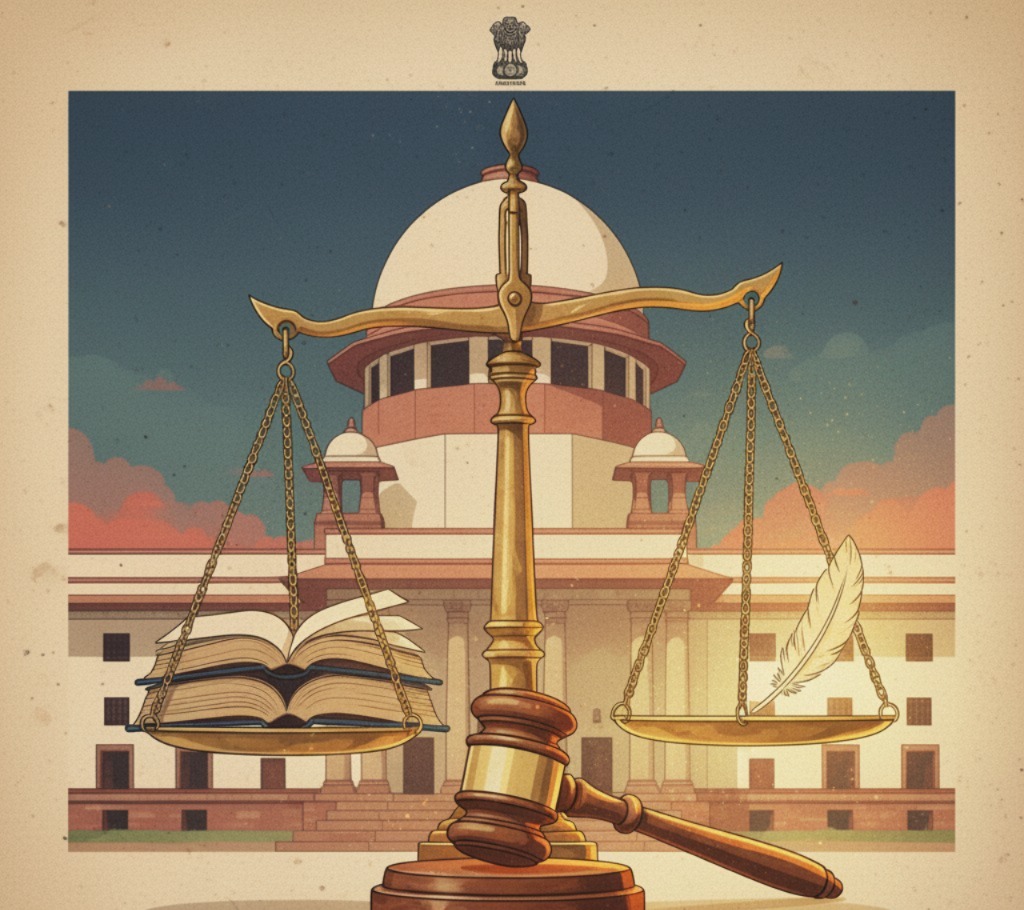
Supreme Court Reinstates Acquittal in Bribery Case: P. Somaraju vs. The State of Andhra Pradesh, 2025 INSC 1263
The Supreme Court, in its judgment on October 28, 2025, overturned the High Court's conviction of a government official in a corruption case, reaffirming the principle that suspicion cannot replace proof when the fundamental elements of demand and acceptance of a bribe are unproven.
Case Background and Allegations
The case involved the appellant, P. Somaraju, who served as the Assistant Commissioner of Labour in Hyderabad between January and September 1996. The prosecution, based on a complaint filed by S. Venkat Reddy (PW-1), alleged that on September 25, 1997, Somarajudemanded a bribe of ₹9,000 to renew three contract labour licenses belonging to Reddy and his nephew. The prosecution claimed Somaraju accepted ₹3,000 immediately and arranged for the remaining ₹6,000 to be paid shortly.
The next day, September 26, 1997, a trap was set by the Anti-Corruption Bureau (ACB) using phenolphthalein-dusted currency. During the trap, the complainant alleged that Somaraju instructed him to place the remaining ₹6,000 in the left drawer of his table.
Conflicting Evidence and Procedural History
Evidence: The tainted notes were recovered from the drawer. However, the appellant’s hand-wash test with sodium carbonate solution showed no color change, indicating he did not physically handle the currency.Somaraju’sdefense was that he was using the toilet at the time, and the complainant planted the money in the drawer.
Trial Court (2003): The Special Judge for SPE & ACB Cases acquitted Somaraju.The court found that the prosecution failed to prove demand and acceptance beyond a reasonable doubt, noting serious inconsistencies in the complaint (e.g., misidentifying the accused as "Rama Raju") and witness testimonies.
High Court (2011): The High Court of Andhra Pradesh reversed the acquittal, convicting the appellant under Sections 7 and 13 of the Prevention of Corruption Act, 1988, and sentencing him to one year of rigorous imprisonment and a fine.
Supreme Court’s Analysis and Verdict
The Supreme Court examined whether the High Court was justified in setting aside the reasoned acquittal. The Court’s analysis focused on fundamental flaws in the High Court’s reasoning:
1. Failure to Prove Demand and Acceptance
The court reiterated that under the Prevention of Corruption Act, the presumption of guilt under Section 20 only arises after the prosecution has successfully proven the foundational facts of demand and acceptance of the bribe. Mere recovery of the money from the appellant's office, especially in an area accessible to others, is insufficient.
2. Unreliable Prosecution Evidence
The Court found the complainant’s testimony to be highly unreliable. Key doubts included:
Inconsistencies: Contradictions in the timing of the complaint versus the alleged demand.
Identity Confusion: The complaint initially named the accused as "Rama Raju," which was a material contradiction.
Mediator Exclusion: The complainant failed to follow ACB instructions by keeping the official mediator (PW-2) outside the office during the transaction, leaving the interaction uncorroborated.
3. Support for the Defense Version
The Supreme Court gave weight to the defense, which was supported by two independent witnesses (DW-1 and DW-2). Both witnesses credibly testified that the appellant was in the toilet while the complainant was alone in the office, lending credence to the claim that the money was planted. The Court found this defense evidence to be genuine and not fabricated.
4. High Court's Errors
The High Court was held to have erred by:
Wrongly inferring that the negative hand-wash test was a sign of "clever evasion" rather than a lack of physical contact, a claim made without supportive evidence.
Substituting its own judgment for the Trial Court’s thorough and reasoned assessment of the evidence without finding that the Trial Court’s view was perverse or unreasonable.
Conclusion
The Supreme Court concluded that the High Court's reasoning was speculative and unsound. Since the prosecution failed to prove the essential elements of demand and acceptance beyond a reasonable doubt, the original acquittal was well-founded.
The appeal was granted, the High Court's conviction was annulled, and the Trial Court's acquittal was reinstated.The court affirmed: "Suspicion, however strong, cannot replace proof. Demand and acceptance must be proven beyond reasonable doubt."
- -Bhumika Garg, Student 1st Year, Himachal Pradesh National Law University, Shimla